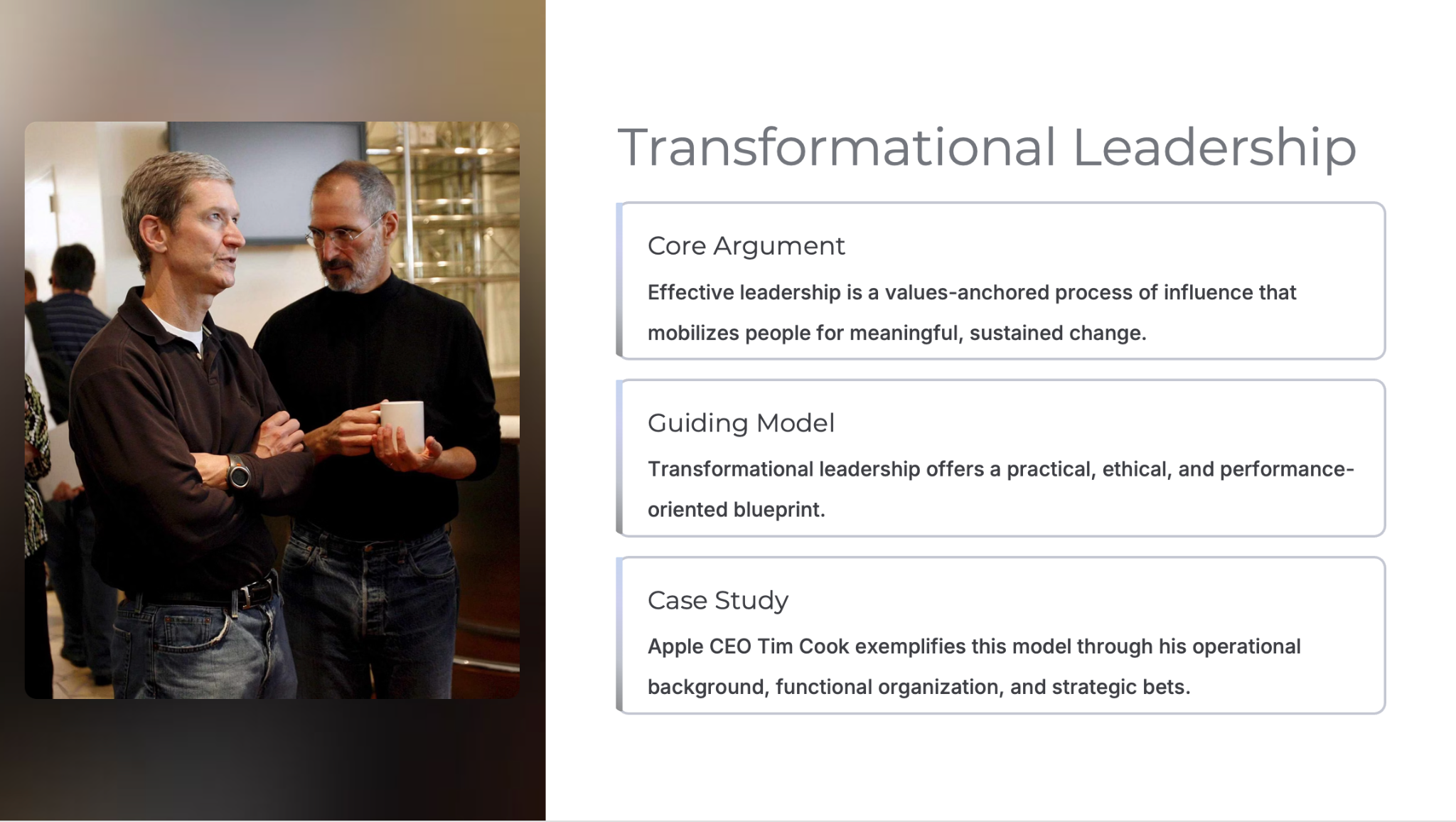
This week Apple announced that Tim Cook will step down as CEO and become executive chairman of Apple’s board, while John Ternus, Apple’s senior vice president of Hardware Engineering, will become CEO on September 1, 2026. I wrote a paper and presentation last November about Tim Cook and transformational leadership, and this announcement makes that work feel much more relevant now.
Tim Cook’s leadership style was always harder to explain than Steve Jobs’. Jobs was the obvious visionary. He was the product storyteller, the stage presence, the person most people associate with Apple’s creative identity. Cook was quieter, more operational, and less mythologized, but that does not mean he was less transformational.
Transformational leadership is about aligning people around purpose, developing capabilities, challenging old constraints, and building a system that can keep improving. That is where Cook’s leadership becomes interesting.
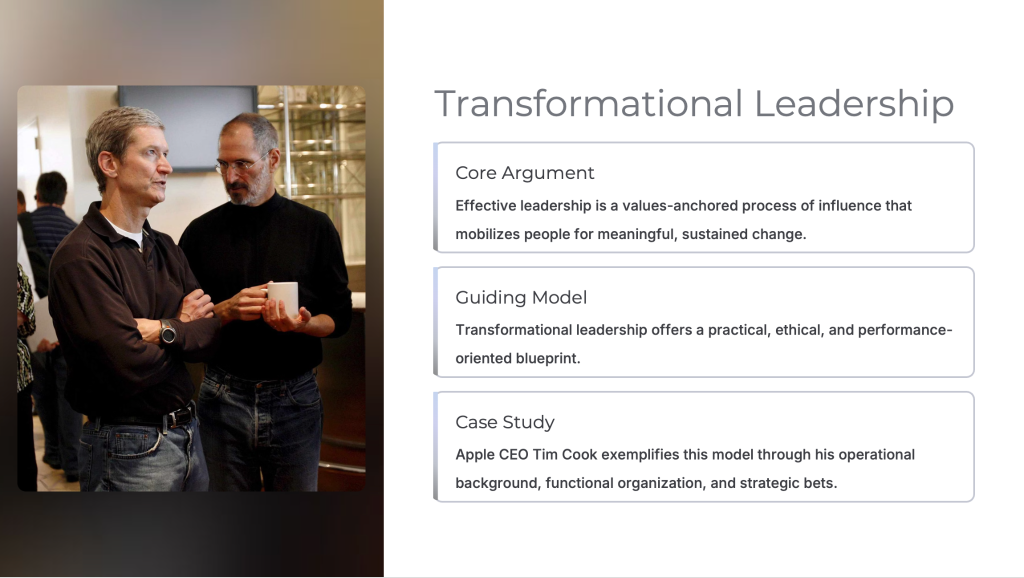
Cook took over Apple in 2011, after already serving as COO and building deep experience in global sales, operations, and the supply chain. This background shaped him into a leader who could see Apple as a system of strategy, design, engineering, logistics, privacy, and customer experience all connected together. That systems view became one of his biggest strengths.
One example is privacy. Cook consistently positioned privacy as a human right, not just a product feature. The tone at the top shapes the company culture. If engineers and designers know privacy is a core value, then user trust becomes part of the product process. This is idealized influence, the leader acts as a credible role model and gives the organization a standard to follow.
Cook also showed inspirational motivation through Apple’s functional structure. Apple is not organized like a typical company where each product division runs like its own mini business. Instead, experts lead functions, and the company is pushed toward the integrated products that work together. This is Cook reinforcing the message that great products are everyone’s job.
The Apple Silicon transition is the clearest example of intellectual stimulation. Moving the Mac away from Intel was not a small update. It required hardware, software, tools, developers, and supply chains to move together. It challenged a major constraint in Apple’s product strategy and forced the company to solve hard cross-domain problems. The result reshaped the Mac and made Apple’s ecosystem even more connected.
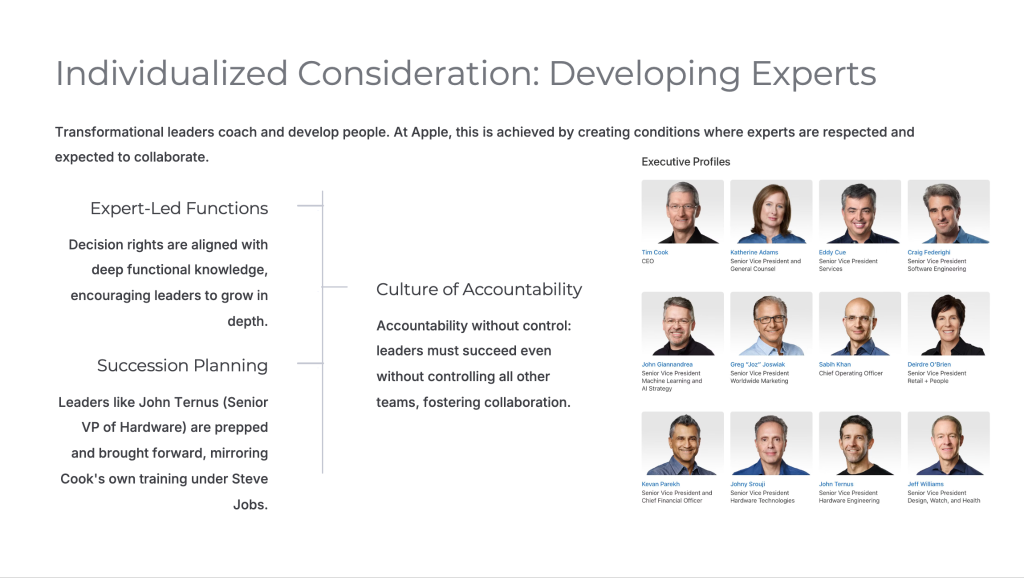
Now the John Ternus transition adds another layer. In my original paper, I mentioned that Ternus looked like a possible successor because Apple’s expert led culture develops leaders from within. That is individualized consideration at scale. It is not just personal coaching behind closed doors; it is building an organization where experts grow into larger responsibilities.
Cook proved transformational leadership looks like operational discipline, values, patience, and succession planning. Steve Jobs made Apple feel magical. Tim Cook made Apple durable. And now, with John Ternus stepping in, we get to see whether that system can keep transforming without Cook in the CEO chair.
Comment what do you think about Tim Cook and his influence on Apple.
Discover more from Shayan Hosseini
Subscribe to get the latest posts sent to your email.
